
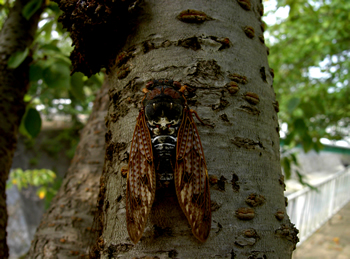
Their buzz-saw song is part of summer’s soundtrack. On a hot day, the long, loud cry of the cicada cuts through the quiet with an intensity greater than the insect’s size. Next to one type of termite, cicadas (suh-KAY-dahs) are the longest-living insects but it’s the nature of their life cycle that makes them so unique.
For starters, they spend most of their lives as nymphs, burrowed underground, sucking sap from tree roots. Then literally billions of the black bugs emerge on a single day across much of eastern North America, every 17 years — right on cue. Scientists can’t explain how cicadas know just when to surface, but they do.
An outbreak happens almost every year somewhere, sometimes overlapping with others. With their transparent wings and bulging red eyes, cicadas are instantly recognizable as they cover trees, buildings, telephone poles and virtually anything else that’s vertical, prompting fear or fascination among the people in their path.
On the twilight of their big day, the nymphs inch out of their holes and latch firmly onto anything upright, then finish overnight their metamorphosis into maturity. They shed their old skin and a milky-white cicada emerges. In just hours, the wings become usable and the body darkens as its protective shell hardens.
Ironically, after 17 years of preparation, the cicadas live just five weeks above ground. As reported in National Geographic, their mass emergence adds much-needed air to the soil, prunes the treetops, provides essential nutrients for plants, and sustains thousands of other creatures who feed on them. Even humans eat cicadas which are described as soft and mushy with a taste like cold, canned asparagus! Male cicadas who escape the predators sit in a sunny tree and drum atune on their undersides. “Like a lizard basking in the sun, they orient themselves to maximize sun exposure,” says Indiana University biologist Keith Clay, “which allows them to sing more vigorously.”
Once cicadas reproduce, their main task is over and they die soon after. But not before the female lays her 600 eggs. Six to eight weeks later, those eggs hatch and the 17-year cycle begins again.
When we strip away the clutter of life, we Christians spend most of our lives preparing to do the same three things as the cicadas: emerge into maturity; prepare the way for the next generation; and die, having fulfilled our purpose. All three are noble, necessary pursuits that, if properly understood, lead to great personal fulfillment.
Just as the cicada spends all those years getting strong enough to do what it was meant to do, our spiritual development takes time, patience and constant connection to the life-sustaining Root of God’s love. Next time you look with envy at someone who seemed to mature overnight, remember that most of that process took place unseen over a long period, complete with setbacks and painful lessons learned. So take heart. Growth is never quick and easy.
Ultimately, it involves shedding our skin. “Since you… have learned the truth that’s in Jesus,” says Paul, “throw off your old evil nature and your former way of life… Instead, there must be a spiritual renewal of your thoughts and attitudes.” (Eph. 4:21,22) That’s how we emerge, pure-white in the love and forgiveness of Christ, ready to attach ourselves to everything that’s upright. With the wings of faith and the protective shell of spiritual armor, we seek the high ground, becoming “a new person, created in God’s likeness — righteous, holy and true.” (v. 24)
We’re not here for a long time, just a lifetime, however long that may be. At best, our days are but a breath. But they’re meant to be filled with purpose that comes of improving our surroundings through service and sacrifice, and we’ll be most vigorous in our witness when we align our lives so we’re fully exposed to the Son.
Metamorphosis and maturity culminate in a sense of mission. Once we share our faith and help perpetuate that great cycle of the saved, we can die content and await that great day when, right on cue, billions of us will emerge into eternity at once, never to die again.