
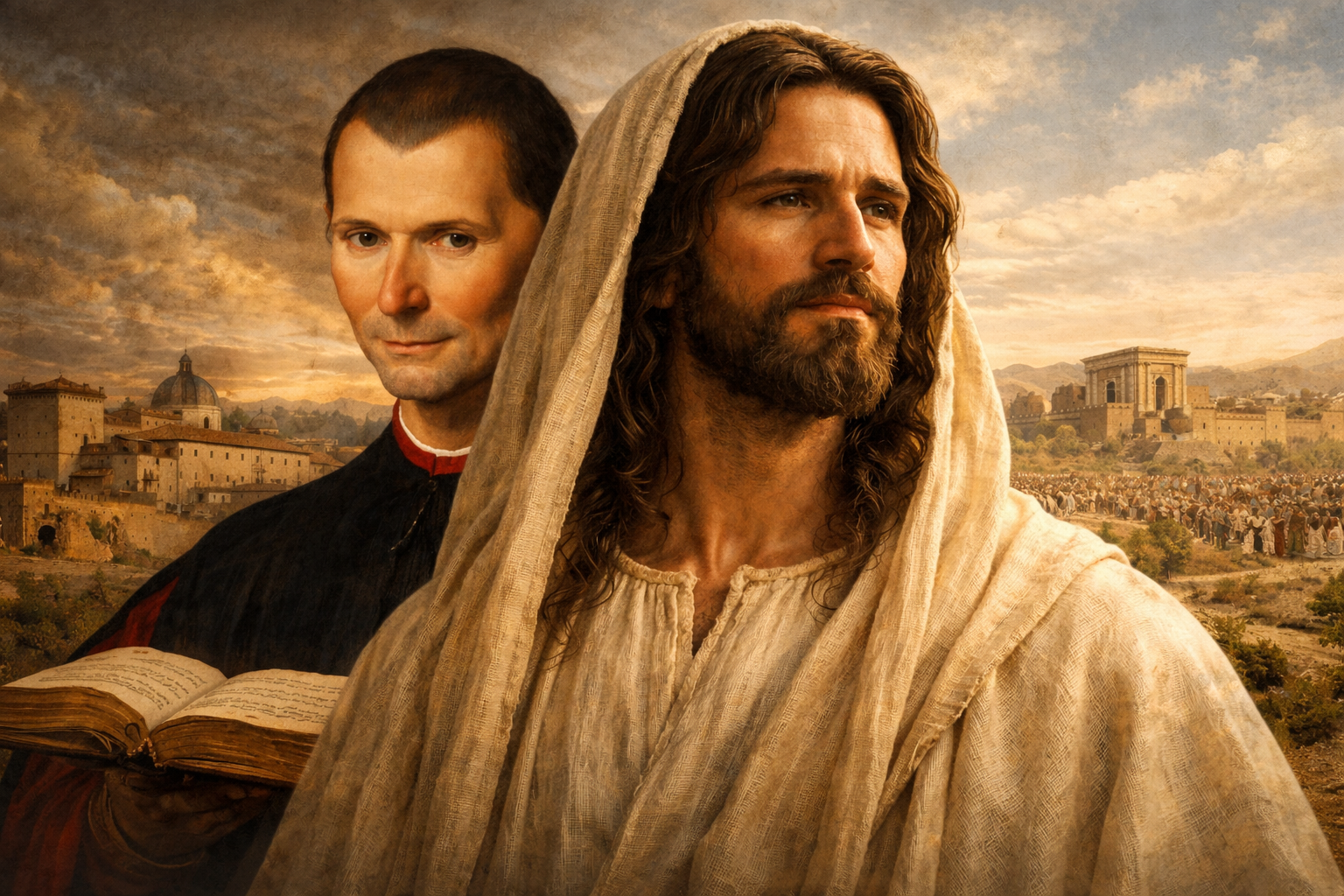
Most Christians instinctively keep Jesus and Machiavelli in separate categories. Jesus is the Son of God, the embodiment of truth and love. Machiavelli is the patron saint of political cynicism, famous for advice that sounds cold, calculating, and self serving.
And yet, if we slow down and read both carefully, something surprising appears.
Jesus speaks constantly about motives, power, image, loyalty, crowds, influence, fear, courage, timing, and the hidden currents of the human heart. Machiavelli does too. Jesus never compromises righteousness, but He is absolutely strategic. Machiavelli is often amoral, but he is perceptive about how people behave, how institutions work, and how leaders lose influence by being naïve.
This article does three things:
- Describes Jesus and His teachings, with a focus on His practical wisdom.
- Describes Machiavelli and his major ideas, especially from The Prince.
- Compares them, showing real similarities and also the important differences.
And then we will look at moments where Jesus, while never sinful, acts with a kind of holy “Machiavellian” shrewdness. Not manipulation. Not deceit. But strategic wisdom in a world full of broken motives.
Who Jesus Is and What He Taught
Jesus of Nazareth (~4BC–30AD) is the central figure of Christianity: God in the flesh, the promised Messiah, the Savior who lived sinlessly, taught with authority, died for sins, and rose again.
Christians often summarize Jesus’ teachings with words like grace, love, mercy, forgiveness, repentance, humility, and faith. All true.
But Jesus’ teaching is also loaded with realism about people.
Jesus understood human nature better than anyone
The Gospels repeatedly show that Jesus knew what was in people, what they were thinking, and what they would do next. He knew crowds could praise Him one day and demand His death the next. He knew religious leaders could look holy and still be driven by envy, pride, and control.
Jesus warns about hypocrisy (Matthew 23), shallow faith (Matthew 13), and the desire for power dressed up as spirituality (Mark 10:42–45). He tells His followers to expect betrayal, persecution, and false teachers (Matthew 24).
Jesus taught integrity, but not naïveté
Jesus commands love of enemies (Matthew 5:44), truthfulness (Matthew 5:37), and purity of heart (Matthew 5:8). But He never tells His followers to be gullible.
He tells them plainly: “Be wise as serpents and innocent as doves” (Matthew 10:16).
That one sentence alone is enough to make some people uncomfortable, because it implies two things at once:
- Innocence is required.
- Wisdom, even in the face of predators, is also required.
Jesus wants His people to be good, but not easily used.
Who Machiavelli Was and What He Taught
Niccolò Machiavelli (1469–1527) was a Florentine political thinker and government official during a violent, unstable era of Italian city states, shifting alliances, coups, foreign invasions, and public betrayals.
His most famous work is The Prince, often treated as a manual for rulers. It is short, sharp, and blunt. Machiavelli’s reputation comes from advice that seems to detach politics from morality.
It is important to say this clearly: Machiavelli is not Scripture, and Christians should not treat him like a moral guide. But he is a valuable case study in how power operates in a fallen world.
Key Machiavellian ideas, in plain language
Here are several themes that matter for our comparison.
1. People are inconsistent and often self interested
Machiavelli repeatedly assumes people will abandon you when it is costly to stay loyal. They will praise you when you benefit them and turn on you when you do not.
2. Appearances matter more than leaders want to admit
He argues that leaders must manage public perception. What people think is often more influential than what is actually true.
3. Timing and decisiveness matter
Indecision loses respect. Hesitation invites challengers. A leader must act at the right moment, not merely have good intentions.
4. Fear can be more reliable than love
This is his most quoted idea. Machiavelli says it is safer to be feared than loved if you cannot be both. His reasoning is that love is fragile, fear is sturdier.
Christians should be careful here. Jesus does not lead by intimidation. Yet Scripture does teach the fear of the Lord, and it does teach that consequences shape behavior. Machiavelli is describing a dynamic. Jesus redeems the human heart. They are not solving the same problem in the same way.
5. A leader must not be naïve about evil
Machiavelli assumes enemies exist, betrayal happens, and moral language is often a costume for ambition.
The Surface Contrast: Why They Seem Opposite
At first glance, Jesus and Machiavelli appear to be opposites.
- Jesus calls for surrender, humility, truth, and sacrificial love.
- Machiavelli seems to justify deceit, coercion, and “whatever works.”
So how can anyone see similarities?
Because similarity does not mean sameness.
You can share an understanding of human nature and strategy while having completely different ethics, goals, and methods.
That is the key.
Jesus and Machiavelli both see the world as it is. Jesus also reveals the world as it should be and provides the power to change it.
Machiavelli describes survival in a brutal political arena. Jesus builds a kingdom that outlasts every arena.
Shared Ground: Where Their Thinking Overlaps
1. Both assume human nature is unreliable without transformation
Machiavelli assumes people are fickle.
Jesus also teaches that the human heart is a problem at the core: “Out of the heart come evil thoughts” (Matthew 15:19). He is not surprised by betrayal. He predicts it.
This is not cynicism. It is realism.
Jesus does not trust crowds with His mission. He does not hand His strategy over to the moods of the moment.
2. Both emphasize wisdom, not just goodness
Machiavelli: Good intentions do not protect you from bad actors.
Jesus: Innocence alone is not enough. “Wise as serpents” (Matthew 10:16).
In other words, being kind is not the same thing as being wise. Jesus demands both.
3. Both understand power, influence, and institutions
Jesus confronts religious institutions, exposes public hypocrisy, and dismantles false authority with words so precise His opponents cannot trap Him.
Machiavelli writes about how institutions protect themselves, how rulers maintain control, and how challengers exploit weakness.
Different aims, same awareness: systems are real, motives are mixed, and words matter.
4. Both are deeply aware of perception and public narrative
Machiavelli is famous for advising leaders to manage appearances.
Jesus regularly reframes narratives.
- The “good guys” are sometimes wolves in religious clothing (Matthew 7:15).
- The “sinners” sometimes go home justified while the religious elite do not (Luke 18:9–14).
- The “clean” can be far from God, and the “unclean” can be closer than anyone expects (Mark 7).
Jesus does not play to image, but He understands how image controls people, and He disrupts it.
5. Both treat timing as essential
Machiavelli stresses decisiveness and timing.
Jesus repeatedly speaks in terms of timing: “My hour has not yet come” (John 2:4; John 7:6). He withdraws when the crowd tries to seize Him prematurely (John 6:15). He enters Jerusalem publicly at the moment that fulfills prophecy and forces the conflict to its climax (Luke 19:28–44).
Jesus is never rushed by pressure. He is never pulled off mission by noise.
Examples Where Jesus Was “Machiavellian” in Words and Actions
Here is where we need careful language.
Jesus is not manipulative. He is not immoral. He never lies. He never uses people as pawns.
But Jesus is strategic, shrewd, and sometimes elusive, because He is dealing with hostile motives and He refuses to let evil set the terms.
If “Machiavellian” means crafty for selfish ends, then no, Jesus is not Machiavellian.
If “Machiavellian” is being used here in the looser, everyday sense of strategic, hard to trap, and wise about human behavior, then yes, Jesus often acts in ways that would surprise people who imagine Him as gentle but politically clueless.
1. “Render to Caesar” and the perfect escape from a trap
Religious leaders ask Jesus about paying taxes to Caesar (Matthew 22:15–22). It is not a sincere question. It is a trap.
- If He says, “Do not pay,” they can accuse Him of rebellion.
- If He says, “Pay,” they can paint Him as compromising with Rome.
Jesus asks for the coin and answers: “Render to Caesar the things that are Caesar’s, and to God the things that are God’s.”
He escapes the trap, exposes their hypocrisy, and reframes the entire question into a deeper issue of allegiance.
That is strategic brilliance, delivered calmly.
2. “Let him who is without sin cast the first stone”
In John 8:1–11, a woman is brought to Jesus, accused of adultery, surrounded by men eager to corner Him.
If Jesus says, “Stone her,” He looks harsh, and they can accuse Him of abandoning mercy. If He says, “Do not stone her,” they can accuse Him of rejecting the law.
Jesus does not argue on their terms. He forces every accuser to examine himself.
One sentence disarms the mob, reveals motives, and protects the woman without denying the seriousness of sin.
Again, not manipulation. Moral clarity with tactical precision.
3. Jesus often refused to answer directly when motives were wrong
Jesus is asked loaded questions constantly.
Sometimes He responds with a question (Mark 11:27–33). Sometimes He tells a parable that reveals the heart of the issue but avoids handing His enemies a legal weapon. Sometimes He says nothing (Matthew 27:12–14).
To some modern readers, this feels evasive. But it is wisdom: do not cast pearls before swine (Matthew 7:6). Do not reward hostile motives with easy leverage.
This is a leadership principle. Not everyone deserves full access to your intentions.
4. Jesus used secrecy and controlled information flow
Jesus sometimes tells people He heals to keep quiet (Mark 1:43–45; Mark 7:36). He withdraws from crowds. He chooses when and where to reveal certain truths.
Why?
Because crowds can turn truth into a spectacle. Because premature fame can derail mission. Because enemies will exploit timing.
In a fallen world, even good news can be weaponized when the wrong people control the narrative.
Jesus is not hiding because He is ashamed. He is controlling timing because He is on mission.
5. He exposed hypocrisy publicly and without hesitation
Matthew 23 is not gentle. Jesus calls religious leaders “whitewashed tombs,” “blind guides,” and “hypocrites.”
This is not spite. It is strategic moral confrontation.
When corrupt leaders use religious language to control others, quiet politeness can become complicity. Jesus makes sure the crowd can see the difference between true holiness and performance.
That is a power move, but it is a righteous one.
6. The Triumphal Entry: a deliberate escalation
Jesus rides into Jerusalem in a way that fulfills prophecy (Zechariah 9:9; see Matthew 21:1–11). This is not accidental. It is a public claim.
He is forcing the question: Who is He?
He is also forcing leaders to act. They cannot ignore Him any longer.
A leader who understands timing chooses when the showdown happens. Jesus does. He is not reactive. He is directing the moment.
7. Jesus’ “divide and reveal” teaching style
Parables are beautiful, but they also function as a filter.
Jesus explains that some hear but do not understand (Matthew 13:10–17). Those who are open come closer and ask. Those who are hostile stay on the surface and miss what is happening.
This is not elitism. It is judgment and mercy at once: truth offered, hearts revealed.
In leadership terms, Jesus does not give the same access to everyone. He draws disciples deeper, while allowing opponents to expose themselves.
The Biggest Difference: Their Ends, Their Ethics, Their Kingdom
This is where the comparison must stay grounded.
Machiavelli’s Question Revisited: Power as Protection, Not Mere Control
Machiavelli’s end is stability, control, and survival.
His question is: How does a ruler keep power in a dangerous world?
When Machiavelli asks how a ruler keeps power in a dangerous world, he is not writing from an armchair. He is observing a reality where kings and princes bore responsibility for entire populations.
In Machiavelli’s world, weakness was not a private flaw. It was a public danger.
A ruler who appeared indecisive, soft, or easily manipulated invited invasion. A neighboring power did not need a moral justification to attack. It only needed an opening. When leaders failed to demonstrate strength, entire countries suffered the consequences through war, occupation, famine, and slaughter.
From that vantage point, power was not merely about ego or dominance. It was about deterrence.
Kings had to make decisions that were difficult, unpopular, and sometimes brutal, not because they loved cruelty, but because projecting strength was often the only way to prevent violence from arriving at their gates. An enemy who feared you was less likely to test you. A rival who doubted your resolve was more likely to strike.
Machiavelli’s realism comes from this harsh environment. He assumes threats are real, enemies are watching, and hesitation costs lives. His counsel reflects a world where moral ideals alone could not stop an army.
This does not make Machiavelli righteous. But it explains why his thinking cannot be reduced to simple villainy.
Machiavelli and the Burden of Rule
It is also important to understand that Machiavelli’s defense of power does not emerge from a casual love of domination. It emerges from the burden of rule.
Kings, princes, and heads of state did not live the same moral life as the common man. Their decisions did not affect only themselves or their families. A single miscalculation could expose entire populations to invasion, starvation, or annihilation. In such a world, leadership was not primarily about personal virtue; it was about survival.
Machiavelli assumes that rulers are always being tested, watched, and measured by rivals. Strength, or the appearance of it, functioned as deterrence. A ruler who appeared weak did not merely invite criticism. He invited conquest. Mercy shown at the wrong moment could cost thousands of lives later.
From this perspective, power was not simply a privilege. It was a responsibility. To fail to project authority was not humility; it was negligence.
This is why Machiavelli treats fear as a stabilizing force. Fear, in his framework, is not sadism. It is prevention. An enemy who fears your resolve is less likely to attack. A rival who doubts your strength is more likely to exploit you. The ruler’s moral burden, as Machiavelli sees it, is to prevent chaos before it arrives.
This does not mean Machiavelli is correct in all his conclusions. But it does mean his reasoning is grounded in a real distinction between private morality and public responsibility. The common man can afford idealism in ways a ruler often cannot. The king answers not only for his soul, but for the safety of his people.
Machiavelli writes from a world where failure in leadership does not result in embarrassment, but in bloodshed.
The basic realities Machiavelli observed have not disappeared; they have only changed their outward form.
Scripture acknowledges that evil must be restrained in the present world, affirming that authority exists in part to limit chaos and wrongdoing until God brings all things fully under His rule (Romans 13:1–4; 1 Peter 2:13–14).
This recognition of authority as a restraining force does not mean all authority is just, righteous, or beyond moral judgment; Scripture consistently holds rulers accountable to God and condemns authority that becomes corrupt, oppressive, or self-serving.
Jesus does not reject coercive power because He lacks authority, but because His authority is of a higher order, one that exposes, judges, and ultimately overcomes evil rather than merely restraining it.
Jesus and Power: A Different Role, the Same Awareness of Evil
Jesus, however, occupies a fundamentally different role.
He is not charged with protecting borders or raising armies. This does not mean Jesus lacked power. It means He possessed it fully and chose not to wield it in the ways people expected. His kingdom is “not of this world” (John 18:36). And yet, Jesus does not ignore power, conflict, or evil.
He speaks constantly of authority, dominion, and victory.
Jesus confronts evil not with legions, but with truth. He casts out demons, commands storms, exposes corruption, and speaks of Satan as a real adversary, not a metaphor. He warns that evil seeks entry points, that compromise gives it ground, and that divided houses fall (Matthew 12:25–29).
When Jesus speaks of binding the strong man before plundering his house, He is using the language of conquest and authority. When He warns against giving the devil a foothold, He acknowledges that evil advances where vigilance collapses.
In this sense, Jesus is not passive. He is authoritative.
Jesus and Machiavelli both understand power. The difference is where that power is exercised and to what end.
Machiavelli focuses on restraining external chaos through fear, deterrence, and decisive action. Jesus confronts internal corruption, spiritual bondage, and deception, defeating them not by intimidation, but by righteousness, obedience, and sacrificial strength.
Two Worlds, Two Missions, One Shared Realism
Machiavelli assumes that if evil is not confronted with force, it will advance.
Jesus assumes that if evil is not confronted with truth and authority, it will also advance.
Both refuse naïveté.
Both understand that evil does not retreat because one hopes it will.
Both recognize that leadership requires resolve, courage, and a willingness to act rather than drift.
Jesus simply wages His war on a deeper battlefield, where the true enemy is not flesh and blood, and the victory He secures cannot be overturned by another invasion.
Jesus’ end is redemption, truth, and a kingdom not built on coercion
Jesus’ question is: How does God rescue sinners and establish a kingdom that outlasts death?
Machiavelli is willing to use morally compromised means because his target is a temporary political outcome.
Jesus never compromises. His kingdom advances through truth, sacrifice, and resurrection power.
Love and fear: what each one means
Any discussion of power eventually leads to the question of fear. Power, when it is real, carries weight. It demands a response. The issue is not whether fear exists, but what kind of fear is being invoked, and to what end.
And while Jesus is One to be loved, He is also certainly One to be feared, because His authority is real and total. Scripture tells us plainly that the fear of God is the beginning of wisdom. This is not a fear rooted in cruelty or instability, but in holiness, authority, and truth. Jesus is both infinitely loving and infinitely authoritative. He is gentle with the repentant, and unyielding toward evil. To love Him rightly is also to revere Him deeply.
Machiavelli’s famous line about fear and love is rooted in distrust of people.
Jesus does not build His mission on intimidation. Yet He also speaks of judgment, consequences, and the fear of the Lord. He is not soft about reality.
The difference is that Jesus uses warnings to call people to life. Machiavelli uses fear as a tool to maintain control.
Why This Comparison Can Help Christians Today
Many believers have been taught that being “Christlike” means being endlessly nice, easily used, and allergic to conflict. That is not the Jesus of the Gospels.
Jesus is gentle and lowly (Matthew 11:29), and He is also untrapable.
He loves people, and He also confronts them.
He serves, and He also exposes.
He forgives, and He also warns.
He dies for sinners, and He also refuses to be controlled by sinners.
So what do we learn?
1. Wisdom is not a lack of love
Sometimes love looks like a direct answer. Sometimes love looks like refusing to play a crooked game.
2. Christians should be innocent, not naïve
Matthew 10:16 is not decoration. Jesus expects His people to recognize wolves.
3. Motives matter as much as words
Both Jesus and Machiavelli agree that people often say one thing and mean another. Jesus calls us to purity, but He also teaches discernment.
4. Strategy can be holy when it serves truth
Planning, timing, boundaries, and careful speech are not unspiritual. They can be acts of obedience.
Jesus did not stumble into the cross. He walked toward it on purpose, at the right time, on His Father’s schedule.
A Closing Thought for Grace Centered People
If you see kinship between Jesus and Machiavelli, you are probably noticing something real: both take human nature seriously.
The difference is that Machiavelli accommodates human brokenness. Jesus confronts it, exposes it, and heals it.
Machiavelli teaches how to rule people.
Jesus teaches how to save people.
And along the way, Jesus shows believers something we need more than we realize: righteousness without wisdom is easily exploited, but wisdom joined to righteousness becomes a steady force that evil cannot easily corner.
“Wise as serpents and innocent as doves” (Matthew 10:16) is not a contradiction.
It is the shape of mature Christian living in a complicated world.